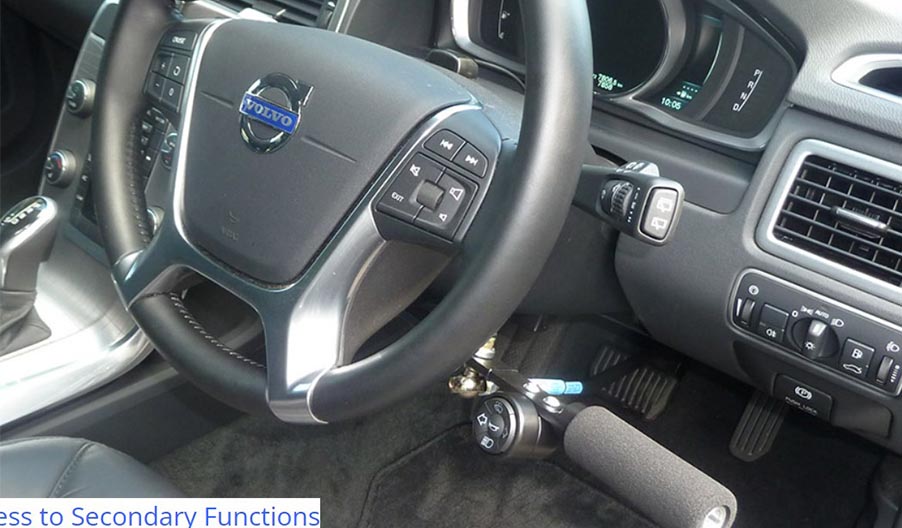
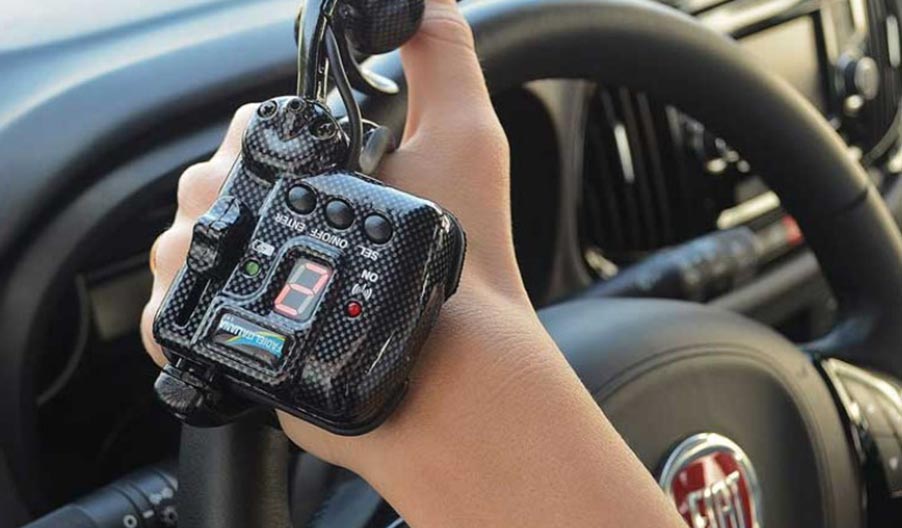
There is a wide range of vehicle modifications on the market which enable people with injury or disability to drive a vehicle and/or to access a vehicle.
Driver modifications:
- spinner knobs and other steering aids
- electronic steering aids eg steering knobs and satellite accelerators
- push/pull and push/pat hand controls
- over/under-ring accelerator
- indicator extension levers
- left foot accelerator
- automatic transmission conversion
Passenger / vehicle access modifications:
- wheelchair accessible conversions and fitouts
- wheelchair hoists and ramps
- lowered floors
- wheelchair tie-downs and docking stations/pins
- seating conversions
- wheelchair and scooter storage
So What do I do?
The general process with any vehicle modification is as follows:
1) Have an OT assessment and prescription from a qualified Occupational Therapist (must be a driving trained OT to prescribe driver mods). Prescription will usually require the team of client, OT, driving instructor and vehicle modifier to work together to determine the best option.
Clients returning to driving
2) Have lessons with the rehabilitation driving instructor to develop competence with the modifications
3) Have an OT on-road re-assessment if necessary
4) OT liaises with the driving instructor and informs GP/specialist that you have passed
5) Return to GP/specialist to gain new medical certificate,
6) Take updated medical certificate to QLD Transport to have licence endorsed with conditions “M” for medical condition and “V” for vehicle modification
All clients
7) Modifications must be installed and authorised by an approved officer
8) Modifications must also be reported to QLD Transport and a modification plate installed
Earlier in the year, Car Free Me was featured on Channel 9 News. This blog is shared from Car Free Me’s website – for information click here.
The reporters talked to the team about how to prepare for a car free life. Driving cessation is a big step for most people. But it doesn’t mean that it takes away your freedom and independence. In this two minute segment, Channel 9 introduces the Car Free Me program and how it can help senior drivers in Australia.
Watch the video: Older drivers in Queensland preparing for a car-free
What is Car Free Me?
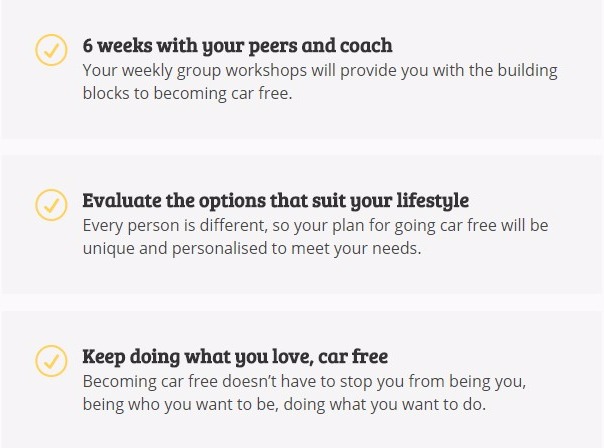
Car Free Me is for people who are still driving and are considering stopping, and for those who have already stopped driving. It is an interactive and supportive program that runs for 6 weeks. Every week, a group of people gets together with their Car Free Me accredited coach. During each workshop we will give you with the building blocks to becoming car free.
“The important thing is that people take that time to plan for it, to think about stopping driving”, said Dr Theresa Scott, academic at The University of Queensland and member of the Car Free Me research team.
“We are here to support you in your decision and preparation for a car free life. We help you evaluate the options that suit your lifestyle so you can continue to do what you love, without needing a car.”
The participants so far have been very pleased with the program. A Brisbane workshop participant wrote: “I have learned about finding alternative means of transport, planning with more wisdom, the search for best retirement options. The information supplied, support and encouragement, professionalism of the program have all been very useful”.
Recommended reading: How does Car Free Me work?
When do I know I need to stop driving?
Did you know that elderly drivers are the safest drivers? Age is not a factor determining whether or not one should stop driving. However when you start facing new health challenges (like mobility issues and vision impairment), this is when you need to start thinking about alternatives.
At 79, Ross McKinnon still drives everyday and has a clean bill of health. But he told Channel 9 that “it’s important to recognise that everybody will have to make that change.” Safe mobility is essential to healthy ageing.
“Don’t leave it to the last minute to start preparing for your car free life.”
Car Free Me in regional areas of Australia
Everyone should be able to have access to the help they need. Thanks to telehealth trials, the Car Free Me program will be trialled outside of urban, metropolitan areas.
What is telehealth? The Department of Health defines it as “the use of telecommunication technology for the purpose of providing health education over a distance”. That is, you will be able to chat and see your Car Free Me coach using video-conferencing. Easy and effective.
Can I help you?
Please contact me at Driving Well Occupational Therapy if you have concerns about an elderly client’s / patient’s / loved one’s driving.
#olderdrivers #occupationaltherapy #practicaldrivingassessment #drivingcessation
My beautiful Great-Aunty Joanie (pictured here a few years ago with my son Henry, now 3) has travelled the world, loves going to the ballet and theatre, and has never driven. She has survived almost a century on planes, trains and bus tours, and more recently gets around with transport help from friends and family, and of course taxis.
Recently, at 97 years young, she told me that she asked her doctor to assist her with obtaining the Taxi Subsidy Scheme to help her with transport costs, and was told she wasn’t eligible. So, I decided to have a closer look.
What is the Taxi Subsidy Scheme?
The Taxi Subsidy Scheme (TSS) provides a subsidy for taxi travel at half the fare, for people that meet one of six eligibility criteria. It is provided by the QLD Department of Transport and Main Roads for permanent Australian residents living in Queensland.
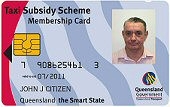
The TSS looks like an ID card and has your photo – you present this to the driver and at the end of the journey you are charged half the fare, up to a maximum of $25.
The eligibility criteria are fairly straight forward – except for Category 2 – Mobility Impairment.
It says that the person “has a physical disability or a medical condition that restricts the person from walking, unassisted and without a rest, 50m or less” or “has a physical disability or other medical condition requiring the person to carry treatment equipment which restricts them from walking unassisted and without a rest 50m, or requires someone else to carry the equipment”.
Confused yet? What does this mean?
In basic terms, the person applying for the taxi subsidy needs to have a medical condition that impacts on their mobility in one of the following ways:
- they need to use a mobility aid such as a walking stick or four wheeled walker
- they use the mobility aid for outdoor activities such as going to the doctor or going shopping
- they can’t walk more than 50m without an aid or a rest: this may be due to factors such as pain or shortness of breath
- they can’t go up and down 3 steps independently: typically can’t get on a bus or access train stations on their own
- they have had falls in the last 12 months
- they are at high risk of falls: to determine falls risk, a physiotherapist or occupational therapist can complete a Timed Up and Go (TUG) test – a TUG score of 12 seconds or more indicates that the person is at high risk of falls, and would be eligible for the taxi subsidy
- they carry treatment equipment such as an oxygen cylinder
- they are assessed by a physiotherapist or occupational therapist as requiring “1 x assist mobility”: meaning that they need another person to physically assist them to mobilise
What else do you need?
A GP, occupational therapist or physiotherapist can complete the TSS application for people eligible for Categories 1 and 2 (severe mobility impairment). The form and details to submit the TSS application are on the website. You also need two passport-sized photographs, witnessed by a health professional / JP / lawyer / police officer / pharmacist.
“It’s the best thing!”
Aunty Joanie
You’d think at 97 years of age it would be a no-brainer to be given access to the taxi subsidy!
I was able to demonstrate Aunty Joanie’s eligibility on Category 2: Mobility Impairment with the following information:
- Aunty Joanie’s health has actually been pretty good and she doesn’t have any medical conditions causing shortness of breath or pain
- at the point of application she hadn’t had any recent falls, but was a bit unsteady on her feet
- she uses a four-wheeled walker when shopping alone
- she was no longer safely able to access steps on her own
- I performed a TUG and her score was 18 seconds, indicating she was at high risk of falls
3 weeks
Aunty Joanie received her Taxi Subsidy Scheme card within 3 weeks of my visit to complete her application. She happily waved it at me and said it was “the best thing” and has used it successfully to go to her local shopping centre and favourite cafe. Love her.
Can I help you?
Please contact me at Driving Well Occupational Therapy if you need a hand in obtaining the Taxi Subsidy Scheme.
I recently sat down with my Mum (Barbara) the other day, and had a chat about her experiences in supporting her mother (my dearly missed, late Nanny) in retiring from driving.
Jenny:T
Thanks for sharing your insights Mum. What initially concerned you about Nanny’s driving?
Barbara:
She had been using a wheelie walker because of her bad hip and difficulty getting out of the car – I was concerned about her reflexes to brake quickly. She always passed the eye test – but there didn’t seem to be any other regulations at the time. I wasn’t aware of any assessment programs at the time.
Jenny:
How did you feel about this challenge
Barbara:
For me – it was hard, but it was the only way. She was fiercely independent and was always the one helping others, not the one being taken care of.
Jenny:
How did you approach the conversation with her – that it might be time for her to give up driving?
Barbara:
I told her, you’ve had a perfect driving record – “you’ve only ever had one accident 50 years ago which wasn’t your fault and you don’t want to be the old lady on the news who has crashed into a childcare centre.” At that time a number of elderly drivers were involved in some serious accidents as reported in the media. Mum understood the implications.
Jenny:
What strategies did you use to encourage her to stop driving?
Barbara:
Various family members would borrow her car for a few weeks at a time, to get used to not having a car around.
Jenny:
Did you do anything else to support her transition to non-driving?
Barbara:
I would take her shopping, then we had a family conference to try to organise rotations of transport assistance. One advantage for family members driving her places and taking her shopping was the social aspect, having coffees or lunch and chats, just getting out and seeing the world. She also had access to transport assistance through DVA. She was concerned about the costs of taxis, but I pointed out if she sold the car she would have heaps of money for taxis.
Jenny:
And what was the outcome?
Barbara:
She said she had liked having the car there “just in case” – she actually stopped driving about a year prior to selling the car. It took time, but she got used to not having the car around. In the end she was convinced, and her grandson (a mechanic) did up the car and sold it for her.
Can I help you?
Please contact me at Driving Well Occupational Therapy if you have concerns about a client’s / patient’s / loved one’s driving.
#practicaldrivingassessment #driving #occupationaltherapy #drivingcessation #olderdrivers #disability #olderdriver
From early on in my career as an Occupational Therapist, I had an interest in pursuing driving assessment. I don’t know what it was exactly…. I don’t particularly enjoy driving that much myself – it tires me out… I’m not really into cars – just give me my reliable Toyota! My husband and I even got by with just one car for many years, and even for about six months after our first child came along.
I like that driving provides me independence and enables me to do the things I want to do.
It enables living. And for so many people, this is true.
In our uni training, OTs learn to develop a balance between independence and safety. In my first job at Blue Care in Brisbane, it became evident to me that many older adults were teetering on the edge of becoming unsafe with their driving (if they weren’t already over the edge).
It was around this time that with my family I personally went through the experience of navigating serious concerns regarding my beloved Nanny’s driving. My family were faced with the dilemma of balancing her independence with her (and the community’s) safety. Of course safety wins in this situation, and she eventually came to the decision to give up driving, and with the support and kindness of family she found other options that enabled her to keep some independence.

Changes in my career led me to managing serious injuries at WorkCover, where I was involved in funding purchase of a new vehicle for a lovely “Grey Nomad” who had sustained spinal injuries in a scooter accident. His main vehicle was a 70 foot caravan, so he needed to be supplied with a modified van that would enable him access in a powerdrive wheelchair, and possibly allow further modifications in the future if he were to progress to return to driving. This vehicle was no less than a full fit-out of a Mercedes Sprinter costing about $70K.
Worth. Every. Penny.
Shortly after this, I was working for a private return to work provider in Brisbane. I was asked to see a courier driver who had sustained a severe right hand injury during a car accident –
don’t worry, I don’t have a picture of his actual injury… in his words with Halloween approaching at the time, his hand looked like it could have been a party entree. It would take many surgeries and months of therapy to recover, and had a poor chance of regaining full function. I just remember talking to his case manager at WorkCover and saying, let’s organise a driving assessment – he will be able to drive an automatic car with a spinner knob and though he mightn’t be able to do his usual work duties, at least he can get to his hand therapy appointments and get some normality back into his life. Not to mention, get his confidence back after his accident. Sadly, I don’t know what ended up happening for this fellow.

Before long, I found myself sitting in the Driving Assessment role at Logan (without yet having done the training), so I took myself off to Sydney for 2 weeks in September 2012 and gained the OT driving assessor qualification. I loved every minute of the course, and then managed the Logan driving service. Staff changes and life have resulted in a break from driving assessment, but my passion for this speciality didn’t fade.
Finally, knee and foot injuries sustained by some men in my family – my husband, cousin and brother-in-law – have resulted in temporary, inconvenient periods of non-driving. My husband’s injured knee was the left one, so we were able to trade in our manual car for an automatic and he was able to drive, however my cousin and brother-in-law sustained right knee and foot injuries this year. I advised them that they can have a left-foot accelerator installed and have driving lessons, but with both fellows being ineligible for funding support, they have decided to wait things out. How great to have the option though! And certainly for someone sustaining a serious permanent injury – a quick modification and some driving lessons would be such a tiny price to pay to get your independence and freedom back.
I am so excited to be doing driving assessments again, and so excited for this new adventure in private practice, and to be “keeping you safe and well on the road”.

Can I help you?
Please contact me at Driving Well Occupational Therapy if you or someone you know needs an OT driving assessment.
"*" indicates required fields

- Resources
- Insights
- Forms
- Driver Focus App
Driving Well Occupational Therapy is a busy practice that provides OT driving assessment and vehicle modification services for people with medical conditions and injuries in Brisbane, Ipswich and northern Gold Coast. We service clients who are self-funding, NDIS and other compensable (WorkCover, NIISQ, TAC, iCare).
On behalf of the team at Driving Well Occupational Therapy and in the spirit of reconciliation, I acknowledge the Traditional Custodians of Turrbul and Yuggera country, where our team live and serve the majority of our clients, as well as to all Traditional Custodians of country throughout Australia and their connections to the land, sea and community. I pay my respects to Elders past and present, and extend that respect to all First Nations people today.
On behalf of the team at Driving Well Occupational Therapy and in the spirit of reconciliation, I acknowledge the Traditional Custodians of Turrbul and Yuggera country, where our team live and serve the majority of our clients, as well as to all Traditional Custodians of country throughout Australia and their connections to the land, sea and community. I pay my respects to Elders past and present, and extend that respect to all First Nations people today.